 RisingStar
- Home
- About Us
- Products
- News
- Video
- Contact
- Send Inquiry
Search
- Home
- About Us
- Products
- News
- Video
- Contact
- Send Inquiry
RisingStar
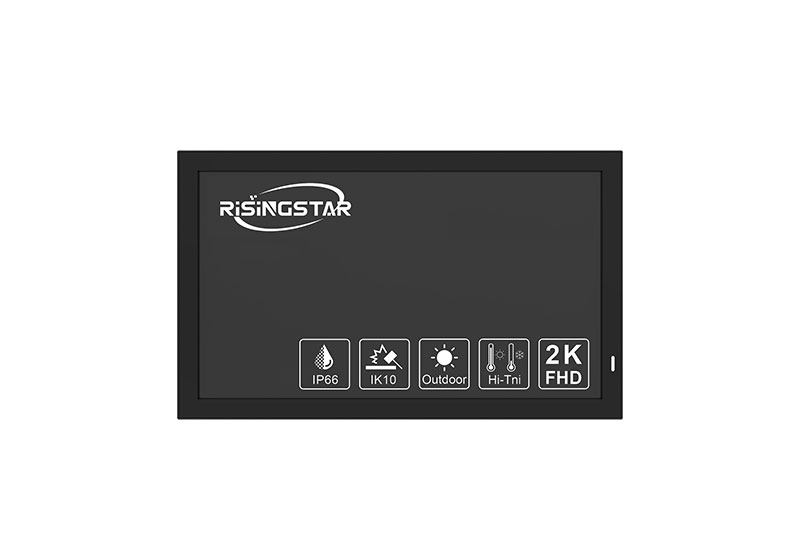
In industrial, military, marine, and outdoor applications, display visibility under direct sunlight and resistance to environmental contaminants are non-negotiable. IP66 waterproof LCD displays have become a critical technology solution for ensuring operational reliability in challenging conditions. The International Protection (IP) rating system, defined by IEC 60529, classifies the degree of protection provided against intrusion from solid objects (like dust) and liquids (like water). An IP66 rating means the device is completely protected against dust ingress (6), and it can withstand powerful water jets from any direction (6)—a crucial specification for high-brightness sunlight-readable LCDs used in environments such as construction sites, oil rigs, defense systems, and agricultural machinery.
The core of an IP66-rated LCD lies not just in the housing but in integrated engineering across multiple domains: display panel technology, backlighting efficiency, optical bonding, sealing materials, and mechanical design. For instance, modern high-brightness LCDs often use LED-backlit panels with brightness levels exceeding 5,000 nits—far above standard indoor displays that typically range between 300–500 nits. This brightness ensures legibility even under intense solar radiation. To maintain this performance while achieving IP66 compliance, manufacturers must employ advanced optical bonding techniques that eliminate air gaps between the display glass and protective cover lens. This process not only enhances contrast and reduces glare but also improves the structural integrity necessary for sealing against water jets.
Testing protocols for IP66 certification follow strict standards set by the IEC. Devices undergo dust chamber testing using fine powder (such as talc) for at least eight hours to confirm total dust exclusion. Water jet tests involve directing a 6.3 mm nozzle at the unit with a flow rate of 100 liters per minute at 10 bar pressure for three minutes from all angles. These rigorous procedures ensure real-world durability, which is essential for mission-critical equipment. Case studies from companies like Calex Electronics and BAE Systems demonstrate how IP66-rated LCDs have reduced field failures in naval command systems and unmanned ground vehicles by over 70% compared to non-sealed alternatives.
Moreover, IP66 compliance influences material selection and manufacturing precision. Silicone gaskets, stainless steel frames, and UV-resistant polycarbonate covers are commonly used. Thermal management is another key consideration—high-brightness LEDs generate more heat, which must be dissipated without compromising the seal. Passive cooling solutions such as aluminum heatsinks or active ventilation (with filtered air intake) are employed depending on the application’s thermal load.
For global deployment, especially in tropical or coastal regions, corrosion resistance (often enhanced via anodized aluminum or marine-grade coatings) is equally important. According to a 2023 report by MarketsandMarkets, the demand for IP66+ sealed displays in outdoor and industrial sectors is projected to grow at a CAGR of 8.7% through 2028, driven by smart infrastructure and IoT-enabled automation. Leading OEMs like LG Display, Sharp, and Innolux now offer IP66-certified modules tailored for embedded systems, emphasizing modularity, power efficiency, and compatibility with ruggedized operating systems like Linux-based RTOS or Windows Embedded Compact.
In conclusion, designing an IP66 waterproof LCD requires a multidisciplinary approach—combining optics, materials science, mechanical engineering, and environmental testing. When correctly implemented, these displays enable reliable human-machine interfaces (HMIs) in some of the world’s most demanding environments, from desert surveillance drones to offshore drilling platforms. Their ability to deliver consistent image quality, robust physical protection, and long-term durability makes them indispensable in today’s connected, automated world.